
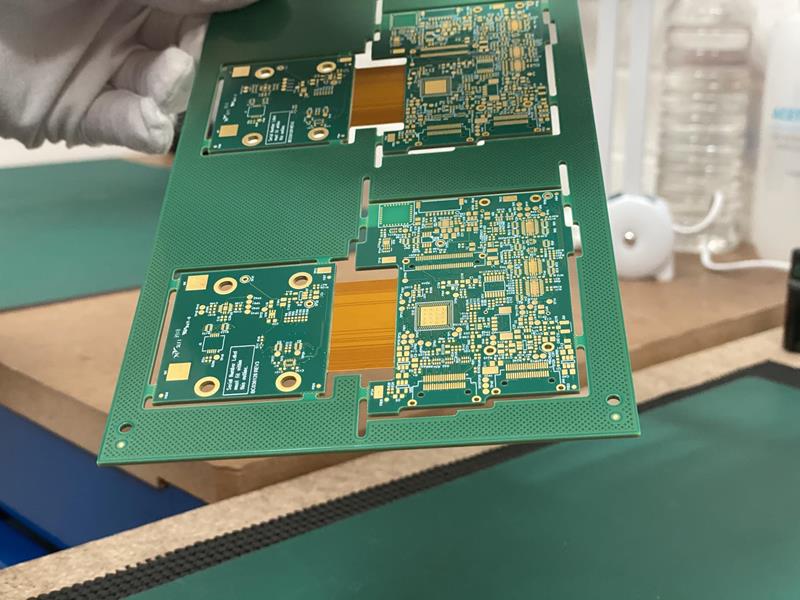
Flex rigid printed circuit boards are a combination of flexible and rigid boards which are connected to each other permanently. They are used where space is limited, offering a higher component density and improved reliability. Flex rigid boards are manufactured by combining multiple flexible inner layers and a rigid external board, with many different design options depending on the application. Flex rigid boards can be used in aerospace, military and health applications as well as smart devices and digital cameras. Reliability Using flex rigid PCBs solves many connectivity issues as they reduce the number of soldered joints and fragile wiring. Components are connected securely with contact and polarity stability. Space-saving Flex rigid PCBs can be designed to fit into smaller spaces, giving more options to designers. They are also lighter in weight than other board types so are ideal in applications such as pacemakers. 3D Design Since flex rigid PCBs can be bent, twisted and rolled to fit into smaller spaces they offer more 3D design options. Component Density Flex rigid boards offer a greater component density giving better mechanical stability.
What are flex rigid PCBs?
Features of flex rigid PCBs


Our Chinese and Thai manufacturing facilities combined with ISO 9001 accreditation means that we can ship high quality flex rigid PCBs anywhere in the world quickly and cost effectively, enabling you to get the product you want at a price that won’t blow your budget.
Speak to our friendly UK-based team to discuss your requirements today.
contact usFlex Rigid PCB technical specification
| Layers | 16 total - 6 flex |
| Technology features | Mixed materials including RF and high speed, standard FR-4, polyimide flex. Adhesiveless or adhesive-based polyimide flex constructions, with cover coat or flexible solder mask materials. |
| Bend performance | Ranges from 90° to a full dynamic flex with 360° range of motion in the flex tail that will withstand multiple continuous cycles throughout the life of the product. |
| Bend features | The bend radius controls the flexibility of the flex portion of the PCB. The flexibility in the flex section depends on how thin the material is, and the bend radius. |
| Materials | RA copper, HTE copper, FR-4, polyimide, adhesive |
| Copper weight (finished) | 2.0oz |
| Minimum width and spacing | Inner layer 3 mil/3 mil (Hoz). Outer layer 3.5 mil/3.5 mil (1oz) |
| Maximum PCB thickness | 3.00mm |
| Maximum dimensions | 550mm - 400mm |
| Surface finishes available | Lead free HAL, ENIG, Immersion Silver, Immersion Tin, ENIPIG, OSP & Hard Gold |
| Minimum hole size | 8 mil (0.2mm) mechanical drill. 4 mil (0.1mm) laser drill. |